

A desk reference for people who lead people
The words for the conversations you can't avoid.
Fifty situations every leader meets, from a first missed deadline to talking with the team after someone leaves. Each one takes ninety seconds: what to avoid, what to say, why it works, and how to adjust it.
$4952 pages · PDF · By Dr. Ebony I. Green

Why waiting costs you
Kindness doesn't cost you standards. Clarity is the kind thing.
"A missed deadline raised in week one is a note between two people. The same miss raised in month four has collected four months of unspoken frustration."
Most leaders don't avoid these conversations because they don't care. They wait for a better first sentence, and the waiting does the damage.
What's inside
Fifty conversations in six sections.
Every entry works the same way, so you can find your footing in ninety seconds.
Avoid
The line most people reach for, and what it actually communicates.
Try this
The words to use instead, ready to say out loud.
Why it works
What the words do, so you can trust them under pressure.
Adjust it
How to change it when your situation is a little different.
All fifty
Performance and accountability
- A deadline was missed and it is the first time
- The same person is missing deadlines repeatedly
- The work is done but the quality is not there
- Someone is not meeting an expectation you never stated
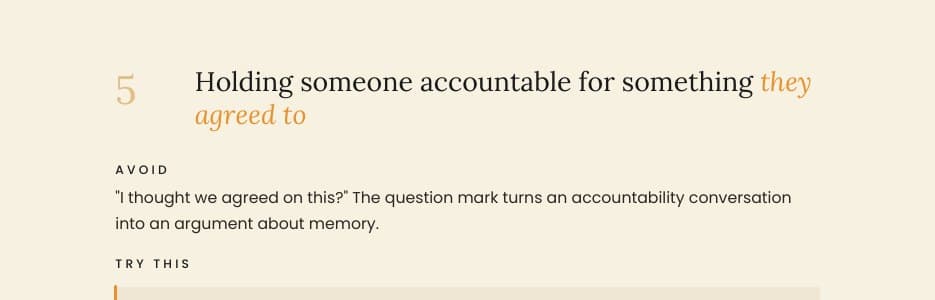
- Holding someone accountable for something they agreed to
- A pattern is not improving after you already raised it
- Asking someone to follow up on a change that has not happened
- Someone's performance dropped and you do not know why
- Praising work without it sounding hollow
- Setting an expectation for someone new
Feedback and correction
- Giving critical feedback to someone for the first time
- Correcting something in the moment, in front of others
- Feedback you have been avoiding for months
- Someone pushes back on your feedback
- Giving feedback to someone more senior than you
- Feedback about how someone shows up rather than what they produce
- Receiving critical feedback from someone who reports to you
- Someone keeps making the same mistake after correction
Conflict and repair
- Two people on your team are in conflict
- Addressing disrespect toward you
- Addressing disrespect toward someone else
- When you got it wrong and people saw it
- Rebuilding after you damaged trust
- Someone brings you a complaint about a colleague
- A decision you made hurt someone and you would make it again
- Following up after a conflict has cooled
Boundaries, workload and saying no
- Saying no to your own boss
- Protecting your team's capacity when work keeps arriving
- Declining a request from someone on your team
- Delegating something you would rather do yourself
- Someone on your team says yes to everything
- Setting a boundary around your own availability
- Telling your team you are at capacity
- Someone is working hours you did not ask for
Change, uncertainty and hard decisions
- Announcing something unpopular
- Carrying a decision you personally disagree with
- Saying you do not know
- A decision people disagree with, after it is made
- Explaining a change when you cannot say everything
- Talking to the team after someone leaves
- Leading through a period where you have no answers
- Delivering a decision that will be read as a loss of trust
Trust, respect and psychological safety
- Someone who used to speak up has gone quiet
- Your team has stopped bringing you problems
- Responding when someone brings you bad news
- Encouraging disagreement without it being performative
- After a mistake that cost the team something
- Recognizing someone in a way that does not feel like management
- Asking for honest feedback about yourself
- Saying something that matters to someone who is leaving
Look inside
Here's how an entry works.
Every entry is short enough to read the day before: the line most people reach for and why it backfires, the words to use instead, why they work, and how to adjust them. Fifteen entries add a note for school and nonprofit leaders.
“I want to ask about something and I am not coming at you about it. The Henderson draft was due Tuesday and came Thursday. What happened?”
Then stop and let them answer.
Who it's for
Anyone with people reporting to them.
Managers, executives, principals, executive directors, HR leaders, team leads, board chairs and shift supervisors.
Fifteen entries carry notes for school and nonprofit leaders, where union representation and mandatory reporting change the conversation.
Where it stops. This is not legal or HR advice. Formal steps, and anything involving harassment, discrimination, retaliation or safety, go to HR or counsel first. The book says so, and says why.

Who wrote it
Written by Dr. Ebony I. Green.
Dr. Ebony I. Green, Ed.D., is an executive culture strategist, former principal and district leader, and TEDx speaker. School districts, foundations and organizations bring her in to strengthen how leaders communicate under pressure.
"Kindness isn't about being soft. It's about being honest in a way that protects the relationship while telling the truth."
How it works
Get the PDF instantly, on screen and by email.
Open it the day before the conversation, not the day after.
Find the entry, say the line out loud, then adjust it to your own words.
Questions
Before you start.
How do I get it?
The download opens on the next screen after you pay, and a copy goes to your email.
Can I buy copies for my team?
Yes. Write to hello@kindsoulchallenge.com and we'll set up team copies.
Is this for new managers?
Yes. Entry 10 covers setting an expectation for someone new, and most entries work from your first week leading people.
Is this HR or legal advice?
No. Formal steps, and anything involving harassment, discrimination, retaliation or safety, go to HR or counsel first.